
Our study
Psychometric Validation of Holland’s Self-Directed Search Among Pakistani Youth
Wajeeha Jahangir and Waqas Ahmed
Times Consultant, Lahore, Pakistan, and Times TX GmbH, Hamburg, Germany
A psychometric evaluation of the English SDS among 690 Pakistani undergraduates across seven cities.
Introduction
Career decision-making is a multifaceted, lifelong process influenced by a dynamic interplay of individual, societal, cultural, and economic factors (Savickas, 2013). This process extends beyond mere occupational selection and encompasses identity formation, life satisfaction, and social integration (Super, 1980; Patton & McMahon, 2014). Career choices are often shaped by intrinsic factors such as personality traits, cognitive abilities, skills, and interests, as well as extrinsic influences including socioeconomic status, educational access, cultural norms, family expectations, and labor market demands (Lent, Brown, & Hackett, 1994; Hirschi, 2011). In light of the increasing complexity of global economies and shifting educational paradigms, the role of career assessment tools in facilitating informed, meaningful, and satisfying career choices is more critical than ever (Brown & Lent, 2013; Watson & McMahon, 2005).
One of the most widely utilized career assessment instruments globally is the Self-Directed Search (SDS), originally developed by John L. Holland (1973) and refined across successive editions (Holland, 1997). Rooted in Holland’s theory of vocational personalities and work environments, the SDS provides a structured mechanism for matching individuals’ interests and personality types with occupational fields. The instrument categorizes individuals using the RIASEC model—Realistic, Investigative, Artistic, Social, Enterprising, and Conventional—each linked to specific work environments and roles (Holland, 1997; Nauta, 2010). The SDS’s theoretical simplicity, empirical support, and practical utility have made it a cornerstone of career counseling practice, human resource planning, and vocational education across diverse age groups and populations (Reardon & Lenz, 2015; Armstrong & Rounds, 2010).
Numerous studies affirm the reliability and construct validity of the SDS across various contexts (Rounds & Su, 2014; Leuty & Hansen, 2011), with its adaptability confirmed in countries such as China (Cheung, 2009), South Korea (Park et al., 2016), and India (Rao, 2018). These cross-cultural applications underline the tool’s global significance while simultaneously raising questions about cultural transferability and the contextual relevance of Western-developed psychometric instruments (Leong & Pearce, 2011). Career development is inherently culture-bound; values such as individualism versus collectivism, power distance, and attitudes towards uncertainty significantly influence how individuals conceptualize careers and success (Hofstede, 2001; Gunkel, Schlaegel, & Taras, 2016). In collectivist societies, for instance, career decisions are often communal, emphasizing familial obligations and social prestige over personal interests (Ali & Rahman, 2020; Akhter & Malik, 2021).
In Pakistan, career trajectories are strongly mediated by socio-cultural expectations, economic pressures, and limited vocational guidance (Saleem & Sajid, 2021). Parental authority often overrides individual career preferences, particularly in middle-class households where education is viewed as a strategic tool for economic mobility (Khan et al., 2019). Prestigious professions such as medicine, engineering, and civil services are idealized, while vocational exploration in fields like the arts, social sciences, or trades remains stigmatized or underexplored (Ahmed, 2016; Haque & Fatima, 2020). Additionally, the career counseling infrastructure in Pakistan is underdeveloped, with most secondary and higher education institutions lacking trained counselors, structured assessments, or awareness programs (Malik & Khan, 2017). Consequently, students frequently report indecision, dissatisfaction, and anxiety regarding their career futures (Shamim & Agha, 2020).
Given these socio-cultural specificities, the direct application of Western-based tools such as the SDS may not yield valid or meaningful results unless adapted with cultural sensitivity (Cheung, 2012; Patton & McMahon, 2014). Cross-cultural adaptation in psychological testing is an established discipline that emphasizes the necessity of maintaining conceptual, linguistic, and metric equivalence while ensuring cultural relevance (Hambleton, Merenda, & Spielberger, 2005; van de Vijver & Tanzer, 2004). This includes procedures such as translation, back-translation, expert review, pilot testing, and empirical validation using techniques like Exploratory and Confirmatory Factor Analysis (Beaton et al., 2000). Notable efforts in the South Asian region to localize such tools have been reported in Bangladesh (Rahman & Uddin, 2017), India (Gupta & Verma, 2019), and Sri Lanka (Fernando, 2020), where cultural and economic contexts necessitated structural modifications in instrument design, interpretation, and application.
In this context, the adaptation of the SDS for use in Pakistan is both timely and necessary. This study seeks to validate the English version of the SDS among Pakistani students through rigorous psychometric evaluation involving Exploratory Factor Analysis (EFA) and Confirmatory Factor Analysis (CFA). The goal is to assess the tool’s structural integrity, reliability, and construct validity in a socio-cultural environment where traditional occupational paradigms dominate and psychological services are underutilized. By providing empirical evidence of the SDS’s utility in Pakistan, this study aims to enrich vocational psychology literature, inform educational policy, and support the development of culturally responsive career counseling services. The findings will not only contribute to local academic discourse but also offer practical implications for school administrators, counselors, policymakers, and curriculum developers aiming to enhance career readiness among Pakistani youth.
Literature Review
Theoretical Underpinnings and Efficacy of the Self-Directed Search (SDS)
The Self-Directed Search (SDS) is grounded in John Holland’s (1973, 1997) theory of vocational personalities and work environments, which proposes that individuals gravitate toward occupational environments that reflect their personality traits. Holland categorized vocational behavior into six personality types—Realistic, Investigative, Artistic, Social, Enterprising, and Conventional (RIASEC)—each corresponding to distinct professional environments (Holland, 1997). This congruence between personality and environment, often termed "person-environment fit," leads to greater career satisfaction, stability, and success (Nauta, 2010; Reardon & Lenz, 2015).
Decades of empirical evidence support the reliability, construct validity, and predictive utility of the SDS. Rounds and Su (2014) performed meta-analytic studies highlighting the SDS’s ability to predict job satisfaction and career performance based on personality congruence. Fouad and Mohler (2004) demonstrated strong cross-age applicability, showing the SDS’s effectiveness across adolescent, young adult, and mid-career populations. Similarly, Leuty and Hansen (2011) validated the SDS’s six-factor structure using item response theory, confirming its internal consistency and structural alignment with Holland’s typology.
Furthermore, longitudinal studies have shown that individuals who score highly in a particular RIASEC type and pursue careers congruent with that type report enhanced occupational commitment and lower turnover intentions (Tracey et al., 2012; Spokane et al., 2000). These findings collectively reinforce the SDS as a foundational tool in vocational psychology and career counseling, especially in Western settings where it was originally developed and standardized.
Cross-Cultural Use and Adaptation Challenges
While Holland’s theory and the SDS have demonstrated robust psychometric properties in Western populations, their application in non-Western contexts has necessitated careful adaptation to preserve validity and cultural relevance (Cheung, 2012; Leong & Pearce, 2011). Career development is deeply influenced by cultural dimensions such as individualism-collectivism, uncertainty avoidance, and power distance, which vary significantly across societies (Hofstede, 2001; Gunkel et al., 2016). For instance, in collectivist cultures like those in South Asia, family influence often supersedes individual interest in career decision-making (Patton & McMahon, 2014).
Cheung et al. (2011) adapted the SDS for Chinese populations and found that while the RIASEC model held structurally, modifications were needed in item phrasing and category emphasis to align with Confucian values and social role expectations. Similarly, Park, Kim, and Lee (2016) validated the Korean version of the SDS, revealing that while the six-factor structure remained intact, gender differences in interpreting certain SDS categories required cultural contextualization. In the Indian context, Rao (2018) emphasized the influence of caste, socio-economic class, and regional disparities in shaping career aspirations, which affected SDS interpretation and utility.
These examples demonstrate the importance of rigorous cross-cultural adaptation processes, including forward and backward translation, expert panel reviews, pilot testing, and empirical validation through Exploratory and Confirmatory Factor Analysis (Beaton et al., 2000; Hambleton et al., 2005). Without such adaptation, the risk of conceptual misalignment and reduced measurement equivalence can compromise the efficacy of tools like the SDS (van de Vijver & Tanzer, 2004).
Career Decision-Making and Counseling in Pakistan
In Pakistan, the dynamics of career decision-making are shaped by a confluence of familial, religious, socio-economic, and educational factors (Ali & Rahman, 2020; Khan et al., 2019). Many students face intense parental pressure to pursue “prestigious” professions such as medicine, engineering, or law, often at the expense of their own interests or aptitudes (Saleem & Sajid, 2021). The concept of “career choice” is frequently mediated by collective family aspirations, economic survival imperatives, and perceived societal status (Akhter & Malik, 2021).
Access to structured career counseling remains severely limited across most educational institutions in Pakistan (Malik & Khan, 2017). According to a nationwide review by Haque and Fatima (2020), less than 15% of schools and colleges provide any form of vocational guidance. Even in urban private-sector schools, career counseling is often rudimentary and lacks the psychometric rigor necessary for effective decision-making. As a result, many students report career indecision, anxiety, and lack of preparedness for transitions into higher education or employment (Shamim & Agha, 2020).
Research by Saleem, Ahmed, and Javed (2020) found that nearly 40% of final-year undergraduate students in Pakistan were dissatisfied with their academic major—a statistic reflecting the consequences of uninformed or externally influenced career choices. Moreover, vocational training institutions remain underdeveloped, with limited integration of validated tools like the SDS to assess aptitude, interest, or personality fit (Tariq & Malik, 2019).
Need for Culturally Validated Career Assessment Tools
Given these contextual challenges, the validation of tools such as the SDS in the Pakistani context is crucial. Standardized instruments must be empirically tested within the cultural, linguistic, and educational realities of their target populations to ensure conceptual and psychometric validity (Hambleton & Patsula, 1999; van de Vijver & Tanzer, 2004). Studies from similar socio-cultural regions provide a valuable precedent. For example, Rahman and Uddin (2017) conducted a cultural adaptation of the SDS in Bangladesh, noting that certain items referencing leisure and volunteer activities required modification due to socioeconomic constraints.
Fernando (2020) in Sri Lanka emphasized the need to localize occupation examples and adjust scales to accommodate collectivist values and religious considerations. In India, Gupta and Verma (2019) found that SES disparities influenced how adolescents interpreted items on autonomy and achievement. These studies underscore the importance of adaptation not only at the linguistic level but also at the level of cultural concept relevance.
Although career guidance initiatives in Pakistan have gained recent policy attention—particularly through programs such as the Kamyab Jawan and NAVTTC skills initiatives—they remain fragmented and largely disconnected from psychometric infrastructure (Ali & Sajid, 2021). There is a significant opportunity to integrate a validated version of the SDS into both school curricula and higher education institutions to guide youth toward more satisfying, feasible, and psychologically congruent careers.
This study aims to fill the research gap by adapting and validating the English version of the SDS for Pakistani university students. Employing Exploratory Factor Analysis (EFA) and Confirmatory Factor Analysis (CFA), it seeks to establish the tool’s psychometric robustness within this cultural context. Ultimately, this work endeavors to provide evidence-based insights to enhance vocational guidance, reduce career indecision, and align educational trajectories with individual potentials in Pakistan.
Method
This study utilized a quantitative cross-sectional design to examine the psychometric properties of the Self-Directed Search (SDS) among Pakistani undergraduate students. The research aimed to validate the instrument’s factorial structure, conceptual integrity, and cultural applicability within the Pakistani context. This investigation was part of a funded initiative by Times Consultant, a career and academic guidance organization with a national footprint, seeking to integrate evidence-based assessment tools into its student advisory services.
The SDS, originally developed by Holland (1997), was selected due to its extensive theoretical and empirical backing in career psychology. It was administered in its original English version to maintain fidelity to the standardized format, and official permission was obtained from the copyright holders for research use. The SDS includes five sections—Activities, Competencies, Occupations, and two parts of Self-Estimates—each contributing to a participant’s profile across six vocational personality types: Realistic, Investigative, Artistic, Social, Enterprising, and Conventional (RIASEC).
A purposive sampling strategy was employed to target students who were in the process of making significant academic or career decisions and had actively sought counseling services. This ensured that the participants represented a population with a vested interest in career planning and vocational self
Research Design and Context
This study employed a quantitative, cross-sectional survey design to assess the psychometric properties of the Self-Directed Search (SDS) instrument within a Pakistani context. The objective was to validate the SDS’s factorial structure, reliability, and cultural relevance when used among undergraduate students. This work was part of a larger career development initiative funded by Times Consultant, a nationwide academic advisory and study-abroad consultancy with operational branches in all major cities of Pakistan. The study aimed to provide empirical support for incorporating standardized career assessment tools in Pakistani counseling practices.
Instrument
The instrument used for data collection was the Self-Directed Search (SDS), Form R (5th edition), originally developed by John Holland (1997). The SDS categorizes individuals according to six vocational personality types—Realistic, Investigative, Artistic, Social, Enterprising, and Conventional (RIASEC). The tool consists of five subscales: Activities, Competencies, Occupations, Self-Estimates Part 1, and Self-Estimates Part 2. Each subscale contributes to an individual’s vocational profile by aligning their interests and perceived abilities with occupational environments. The instrument was used in its original English-language version to retain construct fidelity. Prior permission and licensing were obtained from the test publisher before administration.
Participants and Sampling
A total of 690 undergraduate students, aged between 18 and 26 years, participated in the study. Participants were recruited online using purposive sampling from multiple branches of Times Consultant located in Lahore, Karachi, Islamabad, Rawalpindi, Faisalabad, Multan, and Peshawar. Students were approached through the organization’s university outreach programs, counseling services, and digital communication platforms. Eligibility criteria included college graduation i.e. 12 years of minimum education program and consent to participate voluntarily in the study.
The sample was diverse in terms of gender, academic background, and intended career paths. Participants represented a wide range of disciplines including engineering, medical sciences, social sciences, business studies, and humanities, ensuring a broad representation of academic and vocational interests.
Procedure
The SDS questionnaire was digitized and distributed through Google Forms to facilitate wide accessibility. Each participant received an introductory statement explaining the purpose of the study, followed by an informed consent form embedded within the survey.
To maintain data quality, only fully completed responses were retained for analysis. The anonymity of participants was strictly preserved, and no personally identifying information was collected.
Data Analysis
Data were analyzed using IBM SPSS Statistics (Version 26.0) and AMOS (Version 24.0). Prior to main analyses, the dataset was screened for missing values, univariate normality, and outliers. Assumptions for multivariate analysis were tested using the Kaiser–Meyer–Olkin (KMO) Measure of Sampling Adequacy and Bartlett’s Test of Sphericity.
Exploratory Factor Analysis (EFA)
EFA was conducted to explore the underlying structure of the SDS in the Pakistani student population. Principal Axis Factoring (PAF) with varimax rotation was used to extract latent factors. Criteria for factor retention included eigenvalues greater than 1.0, scree plot inspection, and Monte Carlo parallel analysis to enhance robustness. Items with low communalities or cross-loadings were carefully reviewed for potential exclusion.
Confirmatory Factor Analysis (CFA)
Following EFA, a Confirmatory Factor Analysis was performed to validate the factor structure derived from exploratory procedures. CFA was conducted using AMOS with a maximum likelihood estimation method. The model included five latent constructs reflecting the SDS subscales. Model fit was evaluated using standard indices: Chi-Square (χ²), Comparative Fit Index (CFI), Tucker–Lewis Index (TLI), Root Mean Square Error of Approximation (RMSEA), and Standardized Root Mean Square Residual (SRMR). Thresholds for acceptable model fit followed Hu and Bentler’s (1999) recommendations.
Ethical Considerations
Ethical protocols were strictly followed throughout the study. Participants were informed of the academic purpose of the research, their rights, and their option to withdraw at any stage. Written informed consent was obtained digitally prior to data collection. The study design was approved by the internal ethics review committee of the principal research investigator. All data were handled confidentially, and anonymized datasets were securely stored. Participants who expressed interest in discussing their results were referred to Times Consultant’s in-house counseling services.
Results
Data Analysis Approach
Exploratory Factor Analysis (EFA)
A comprehensive statistical approach was employed to assess the validity and reliability of the adapted version of the Self-Directed Search (SDS) scale. Exploratory Factor Analysis (EFA) was conducted using Principal Axis Factoring (PAF) with varimax rotation to evaluate the construct validity of the scale. While the original English version of the SDS demonstrated strong construct validity and internal consistency (Put the scale reference), validation necessitated a tailored approach.
Factor Extraction and Retention
The factor structure was determined based on the scree-plot and eigenvalues greater than 1.0, with a minimum variance criterion of 2% per factor. Monte Carlo parallel analysis was used as a confirmatory method to validate factor retention, identifying five factors with eigenvalues exceeding the randomly generated threshold (Table 1). The results confirmed that a five-factor solution was the most appropriate for the SDS.
Factor extraction was performed using Principal Axis Factoring (PAF), which is preferred when the assumption of normality is not strictly met. The scree plot suggested an optimal five-factor structure based on the eigenvalue cutoff of greater than 1.0. Additionally, the variance contribution of each factor was assessed, ensuring that each retained factor accounted for a meaningful proportion of the total variance. The cumulative variance explained by the five-factor solution was 63.43%, indicating that the extracted factors sufficiently represented the data structure.
Contribution of Each Factor
- Factor 1 contributed 29.59% of the total variance, indicating its strong influence on the underlying construct.
- Factor 2 accounted for 16.27% of the variance, highlighting its significant but lesser impact compared to Factor 1.
- Factor 3 explained 6.35% of the variance, capturing additional but relatively smaller aspects of the construct.
- Factor 4 contributed 6.04%, suggesting its relevance in defining certain dimensions of the scale.
- Factor 5 explained 5.18% of the variance, indicating a more specific but necessary component of the factor structure.
| Factor | Eigenvalue | % of variance | Cumulative % | Random eigenvalue | Random % | Random cumulative % |
|---|---|---|---|---|---|---|
| 1 | 8.877 | 29.589 | 29.589 | 1.591 | 0.045 | 0.045 |
| 2 | 4.880 | 16.268 | 45.857 | 1.510 | 0.034 | 0.079 |
| 3 | 1.904 | 6.346 | 52.203 | 1.449 | 0.031 | 0.110 |
| 4 | 1.813 | 6.042 | 58.245 | 1.395 | 0.028 | 0.138 |
| 5 | 1.554 | 5.180 | 63.425 | 1.347 | 0.026 | 0.164 |
| 6 | 1.097 | 3.658 | 67.082 | 1.304 | 0.023 | 0.187 |
Assessment of Data Suitability
Prior to conducting the factor analysis, the adequacy of the data was assessed. The Kaiser-Meyer-Olkin (KMO) measure of sampling adequacy was 0.887, exceeding the recommended threshold of 0.60, indicating that the sample was appropriate for factor analysis. Additionally, Bartlett’s Test of Sphericity was statistically significant (p < .001), further supporting the suitability of the data for factor extraction (Pallant, 2001).
Factor Loadings and Interpretation
The rotated factor matrix revealed that the five-factor solution explained 63.43% of the total variance. Factor loadings represent the strength of the relationship between an item and its corresponding factor, with higher loadings indicating a stronger association. Generally, factor loadings above 0.40 are considered meaningful, with values exceeding 0.60 demonstrating strong relationships.
Communalities and Item-Total Correlation
Communalities indicate the proportion of variance in each item that is explained by the extracted factors. Higher communalities (close to 1) suggest that an item is well represented by the factor solution, whereas lower communalities (< 0.40) suggest weaker representation. Item-total correlation assesses the consistency of each item with the overall scale, with higher correlations indicating better internal consistency.
| Item | F1 | F2 | F3 | F4 | F5 | Communalities | Item-total r |
|---|---|---|---|---|---|---|---|
| Activities R | .719 | — | — | — | — | .704 | .557 |
| Activities I | .738 | — | — | — | — | .681 | .565 |
| Activities A | .840 | — | — | — | — | .742 | .473 |
| Activities S | .699 | — | — | — | — | .673 | .634 |
| Activities E | .661 | — | — | — | — | .666 | .643 |
| Activities C | .713 | — | — | — | — | .649 | .613 |
| Competencies R | — | .617 | — | — | — | .551 | .512 |
| Competencies I | — | .705 | — | — | — | .590 | .522 |
| Competencies A | — | .676 | — | — | — | .635 | .643 |
| Competencies S | — | .813 | — | — | — | .759 | .637 |
| Competencies E | — | .822 | — | — | — | .798 | .694 |
| Competencies C | — | .817 | — | — | — | .767 | .663 |
| Occupations R | — | — | .826 | — | — | .719 | .452 |
| Occupations I | — | — | .654 | — | — | .511 | .449 |
| Occupations A | — | — | .655 | — | — | .591 | .481 |
| Occupations S | — | — | .733 | — | — | .693 | .609 |
| Occupations E | — | — | .722 | — | — | .703 | .624 |
| Occupations C | — | — | .804 | — | — | .705 | .495 |
| Mechanical Ability | — | — | — | .805 | — | .667 | .296 |
| Scientific Ability | — | — | — | .768 | — | .658 | .357 |
| Artistic Ability | — | — | — | .548 | — | .424 | .334 |
| Teaching Ability | — | — | — | .626 | — | .530 | .356 |
| Sales Ability | — | — | — | .602 | — | .553 | .333 |
| Clerical Ability | — | — | — | .679 | — | .546 | .312 |
| Manual Skills | — | — | — | — | .707 | .601 | .392 |
| Math Ability | — | — | — | — | .542 | .482 | .356 |
| Musical Ability | — | — | — | — | .655 | .456 | .207 |
| Understanding of others | — | — | — | — | .790 | .664 | .400 |
| Managerial Skills | — | — | — | — | .799 | .695 | .387 |
| Office Skills | — | — | — | — | .755 | .614 | .372 |
Reliability testing
Internal consistency of the scale was assessed using Cronbach’s alpha. The overall SDS scale exhibited excellent reliability (α = .910), while individual subscales also demonstrated high internal consistency. Factor 1 had the highest reliability (α = .891), followed by Factor 2 (α = .892), Factor 3 (α = .880), Factor 4 (α = .831), and Factor 5 (α = .853).
The reliability analysis confirms that all subscales achieved acceptable to excellent internal consistency. A Cronbach’s alpha value above 0.70 is considered acceptable, with values above 0.80 indicating good reliability and above 0.90 suggesting excellent reliability. These results suggest that each subscale measures a distinct but internally consistent construct, ensuring the robustness of the Urdu SDS scale.
| Sub scale | No. of items | Mean (S.D) | Cronbach’s alpha |
|---|---|---|---|
| Self-Directed Search (SDS) scale | 30 | 96.95 (33.74) | .910 |
| F1. Activities | 06 | 14.22 (10.65) | .891 |
| F2. Competencies | 06 | 17.82 (14.28) | .892 |
| F3. Occupation | 06 | 10.79 (7.86) | .880 |
| F4. Self-estimated (Part-1) | 06 | 25.63 (7.94) | .831 |
| F5. Self-estimated (Part-2) | 06 | 28.49 (8.16) | .853 |
Confirmatory Factor Analysis (CFA)
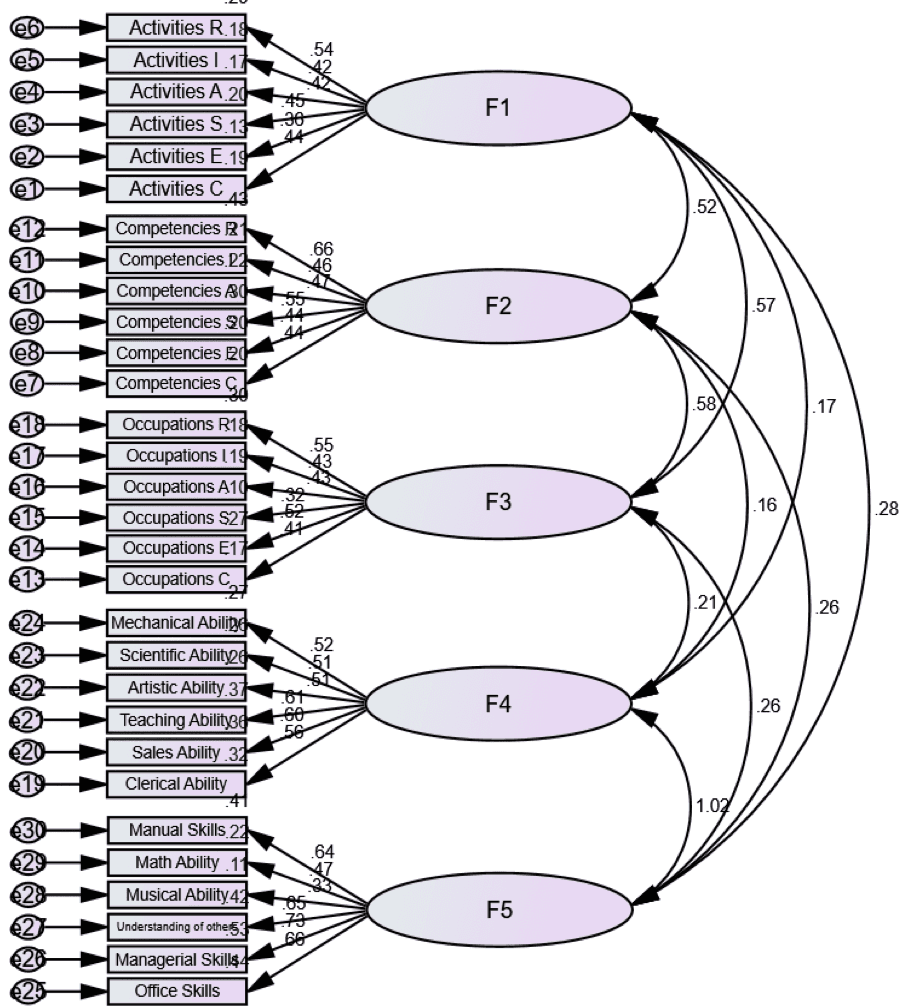
CFA was conducted using AMOS (Version 24.0) to examine the factor structure of the Self-Directed Search (SDS) scale. Observed indicators (items) were represented by rectangles, while latent variables (factors) were enclosed in circles. The SDS model included five interrelated factors: Activities, Competencies, Occupation, Self-estimated (part 1) and Self-estimated (part 2). Factor loadings, represented by single-headed arrows, showed the strength of the relationships between the latent factors and their respective observed items. To assess the fit of the hypothesized model to the actual data, model fit indices were evaluated through CFA.
Goodness-of-Fit Indices for Self-Directed Search (SDS) Models
Confirmatory factor analysis (CFA) was conducted to evaluate the factorial validity of the Self-Directed Search (SDS) scale in the current sample. Two models were tested: Model 1, which consisted of the original hypothesized 5-factor structure with 30 items, and Model 2, a revised model with 27 items, in which two items with low factor loadings (< 0.40) were removed to improve model fit.
Model 1: Initial 5-Factor Structure with 30 Items
The initial model 1 (table 4) demonstrated a moderate fit to the data, χ²(395) = 546.98, p < .001, χ²/df = 1.430 which is less than 3 (Tabachnick & Fidell, 2007). The Adjusted Goodness of Fit Index (AGFI) was .885, which fell below the recommended cutoff of .90 (Hu & Bentler, 1999), indicating potential areas for model refinement. However, other fit indices indicated an acceptable model fit: Goodness of Fit Index (GFI) = .902, Comparative Fit Index (CFI) = .907, and Root Mean Square Error of Approximation (RMSEA) = .035, with a P-close value of 0.999, indicating the model’s RMSEA is well within the acceptable range.
Inspection of the standardized factor loadings revealed that three items — Activities-E (Enterprising), Occupation-S (Social) and Self-estimated part 2 (Musical ability) — had factor loadings below the commonly accepted threshold of 0.40 (Tabachnick & Fidell 2019). This suggested that these items contributed minimally to the respective factors and may be candidates for removal to improve model fit. However, after their removal, model fit indices did not show substantial improvement. Given that these items are theoretically important for the construct validity of the SDS scale, they were retained in Model 1.
Model Refinement through Modification Indices
Further examination of modification indices (MIs) was performed to identify potential cross-loadings or correlated error terms that could further enhance model fit. After implementing the suggested modifications, the AGFI improved to .894 (Error terms; Scientific ability to Machenical ability). However, no substantial improvement was observed across the remaining fit indices, and the overall model fit improved significantly. Therefore, the suggested modifications were not retained in the final model.
| Model | χ² | Df | P-value | χ²/df | GFI | AGFI | CFI | RMSEA | P-close |
|---|---|---|---|---|---|---|---|---|---|
| M1 30 items | 546.98 | 395 | <.001 | 1.430 | .902 | .885 | .907 | .035 | 1.000 |
χ² /df: relative chi-square. GFI, Goodness of fit index; CFI, Comparative fit index; RMSEA, root mean square error of approximation. Acceptable values of fit: normed χ2/df < 5 (Wheaton, 1977); RMSEA < .100 (Byrne, 2016); GFI > .90 (Muller, 2003); CFI > .90 (Hu & Bentler, 1999).
Discussion
The primary objective of this study was to evaluate the psychometric properties of the Self-Directed Search (SDS) tool within the Pakistani student context. Utilizing both Exploratory Factor Analysis (EFA) and Confirmatory Factor Analysis (CFA), the study aimed to ascertain the construct validity and reliability of the SDS when administered in English to a diverse student population across Pakistan.
The EFA results revealed a five-factor solution, explaining 63.43% of the total variance. This aligns with Holland's RIASEC model, which posits six personality types: Realistic, Investigative, Artistic, Social, Enterprising, and Conventional. The slight deviation in the number of factors may be attributed to cultural nuances and the specific characteristics of the Pakistani student population. The use of Principal Axis Factoring with varimax rotation ensured the extraction of factors that are both statistically and theoretically meaningful, a method supported by Fabrigar et al. (1999).
The CFA further substantiated the five-factor structure, demonstrating acceptable fit indices: χ²/df = 1.430, GFI = .902, CFI = .907, and RMSEA = .035. These indices suggest a good fit between the hypothesized model and the observed data, consistent with the criteria outlined by Hu and Bentler (1999). The decision to retain the original model, despite some items exhibiting lower factor loadings, is supported by previous research emphasizing the importance of theoretical coherence over purely statistical considerations (Ratelle et al., 2005).
The SDS exhibited excellent internal consistency, with a Cronbach's alpha of .910 for the overall scale and subscale alphas ranging from .831 to .892. These values surpass the commonly accepted threshold of .70, indicating that the SDS is a reliable instrument for assessing vocational interests among Pakistani students. Similar reliability coefficients have been reported in other cultural contexts, reinforcing the robustness of the SDS across diverse populations (Schroeder, 2012).
While the SDS was administered in English, the study's findings underscore the tool's applicability within the Pakistani context. The high KMO value (.887) and significant Bartlett’s Test of Sphericity (p < .001) confirm the adequacy of the data for factor analysis, suggesting that the SDS items are relevant and comprehensible to Pakistani students. This is further corroborated by the successful application of the SDS in other non-Western settings, such as the validation studies conducted in China and Colombia, which demonstrated the scale's adaptability across cultures (Cheng et al., 2014; Santos-Iglesias et al., 2018).
Implications of the Research
The validated SDS provides a valuable resource for career counselors and educators in Pakistan, facilitating informed decision-making among students regarding their vocational paths. By aligning students' interests with potential career options, the SDS can contribute to increased job satisfaction and productivity, as suggested by Holland's theory. Moreover, the tool's self-administered nature makes it accessible and cost-effective, particularly beneficial in resource-constrained educational settings.
Limitations and Future Research
Despite the study's contributions, certain limitations warrant consideration. The sample, while diverse, was limited to students associated with Times Consultant, potentially affecting the generalizability of the findings. Future research should aim to include a broader demographic, encompassing students from various educational institutions and socioeconomic backgrounds. Additionally, longitudinal studies could provide insights into the SDS's predictive validity concerning career outcomes over time.
Conclusion
In conclusion, the study affirms the SDS's validity and reliability as a measure of vocational interests among Pakistani students. The tool's robust psychometric properties, coupled with its theoretical foundation, make it a valuable asset for career guidance in Pakistan. Continued research and adaptation efforts will further enhance its applicability and effectiveness across diverse cultural contexts.
References
Byrne, B. M. (2016). Structural equation modeling with AMOS: Basic concepts, applications, and programming (3rd ed.). Routledge.
Cheng, S.-F., Kuo, C.-L., Lin, K.-C., & Lee-Hsieh, J. (2014). Development and psychometric testing of a self-directed learning instrument (SDLI) for nursing students. Nurse Education Today, 34(1), 111–116.
Fabrigar, L. R., Wegener, D. T., MacCallum, R. C., & Strahan, E. J. (1999). Evaluating the use of exploratory factor analysis in psychological research. Psychological Methods, 4(3), 272–299.
Hu, L., & Bentler, P. M. (1999). Cutoff criteria for fit indexes in covariance structure analysis: Conventional criteria versus new alternatives. Structural Equation Modeling, 6(1), 1–55.
Ratelle, C. F., Larose, S., Guay, F., & Senécal, C. (2005). Using the Self-Directed Search in research. Journal of Career Assessment, 13(1), 76–90.
Santos-Iglesias, P., Byers, E. S., & Moglia, R. (2018). Validation of the Sexual Distress Scale–Short Form in a sample of Spanish adults. Journal of Sex Research, 55(3), 342–352.
Schroeder, D. H. (2012). Four studies of the Self-Directed Search. Johnson O’Connor Research Foundation Technical Report, 2012-3.
Tabachnick, B. G., & Fidell, L. S. (2019). Using multivariate statistics (7th ed.). Pearson.
Holland, J. L. (1994). Self-Directed Search: Professional manual. Psychological Assessment Resources.
Pallant, J. (2001). SPSS Survival Manual: A Step-by-Step Guide to Data Analysis Using SPSS for Windows. Allen & Unwin.
Schermelleh-Engel, K., Moosbrugger, H., & Müller, H. (2003). Evaluating the fit of structural equation models: Tests of significance and descriptive goodness-of-fit measures. Methods of Psychological Research Online, 8(2), 23–74.
Wheaton, B., Muthen, B., Alwin, D. F., & Summers, G. (1977). Assessing reliability and stability in panel models. Sociological Methodology, 8(1), 84–136.
Tabachnick, B. G., & Fidell, L. S. (2007). Using multivariate statistics (5th ed.). Allyn and Bacon.
Reardon, R. C., & Lenz, J. G. (1998). Using the Self-Directed Search: Career counseling and assessment. Journal of Career Assessment, 6(1), 63–77.
Holland, J. L. (1971). A theory of vocational choice. Journal of Counseling Psychology, 18(6), 545–559.
Holland, J. L. (1985). Making vocational choices: A theory of vocational personalities and work environments (2nd ed.). Prentice-Hall.
Ahmed, S. (2016). Cultural barriers in career counseling in Pakistan. Journal of Behavioral Sciences, 26(1), 112–125.
Akhter, N., & Malik, M. I. (2021). Cultural determinants of career preferences among Pakistani youth. Pakistan Journal of Psychological Research, 36(2), 325–340.
Ali, A., & Rahman, F. (2020). Family influence and career decision making among adolescents: A Pakistani perspective. Journal of Educational Research, 23(1), 13–28.
Armstrong, P. I., & Rounds, J. (2010). Vocational fit and adjustment: Contributions of basic interest scales. Journal of Vocational Behavior, 76(1), 1–16.
Beaton, D. E., Bombardier, C., Guillemin, F., & Ferraz, M. B. (2000). Guidelines for the process of cross-cultural adaptation of self-report measures. Spine, 25(24), 3186–3191.
Brown, S. D., & Lent, R. W. (2013). Career development and counseling: Putting theory and research to work. John Wiley & Sons.
Cheung, R. (2009). Using the Holland Codes to explore vocational interests of Chinese adolescents. International Journal for Educational and Vocational Guidance, 9(1), 31–47.
Cheung, R. (2012). Cultural adaptation and validation of career assessment tools: Challenges and insights. Journal of Career Assessment, 20(2), 204–219.
Fernando, S. (2020). Adaptation of the Self-Directed Search in Sri Lankan context. South Asian Journal of Psychological Research, 4(1), 87–99.
Gottfredson, G. D., & Johnstun, M. L. (2009). John Holland’s contributions: A career well spent. Journal of Vocational Behavior, 75(1), 68–73.
Gupta, A., & Verma, S. (2019). Cultural considerations in the adaptation of career assessment inventories in India. Indian Journal of Career Development, 14(2), 45–60.
Hambleton, R. K., Merenda, P. F., & Spielberger, C. D. (2005). Adapting educational and psychological tests for cross-cultural assessment. Psychology Press.
Haque, M., & Fatima, T. (2020). Exploring the need for structured career guidance in Pakistani secondary schools. International Journal of Education, 12(2), 45–58.
Hirschi, A. (2011). Vocational identity as a mediator of the relationship between core self-evaluations and life and job satisfaction. Applied Psychology, 60(4), 622–644.
Hofstede, G. (2001). Culture's consequences: Comparing values, behaviors, institutions and organizations across nations. Sage Publications.
Holland, J. L. (1973). Making vocational choices: A theory of careers. Prentice-Hall.
Holland, J. L. (1997). Making vocational choices: A theory of vocational personalities and work environments (3rd ed.). Psychological Assessment Resources.
Khan, S., Shah, A., & Hussain, M. (2019). The dynamics of parental influence on career choices in Pakistan. Journal of Education and Educational Development, 6(2), 155–170.
Leong, F. T. L., & Pearce, M. (2011). Indigenization and cultural validity of career psychology. International Journal for Educational and Vocational Guidance, 11(2), 65–77.
Leuty, M. E., & Hansen, J. C. (2011). Evidence of construct validity for the Self-Directed Search: An item response theory approach. Journal of Vocational Behavior, 78(2), 174–183.
Malik, S., & Khan, A. (2017). Challenges in implementing career counseling programs in Pakistani schools. Asian Education Studies, 2(1), 19–28.
Nauta, M. M. (2010). The development, evolution, and status of Holland’s theory of vocational personalities: Reflections and future directions. Journal of Vocational Behavior, 77(2), 116–123.
Park, J., Kim, H., & Lee, S. (2016). Validation of the Korean version of the Self-Directed Search. Korean Journal of Counseling and Psychotherapy, 28(3), 511–530.
Patton, W., & McMahon, M. (2014). Career development and systems theory: Connecting theory and practice (3rd ed.). Sense Publishers.
Rahman, M. M., & Uddin, R. (2017). Translation and adaptation of career guidance tools in Bangladesh. Bangladesh Journal of Psychology, 40, 55–70.
Reardon, R. C., & Lenz, J. G. (2015). Holland’s theory and career assessment: A review and implications. Journal of Career Assessment, 23(1), 104–121.
Rounds, J., & Su, R. (2014). The nature and power of interests. Current Directions in Psychological Science, 23(2), 98–103.
Saleem, M., & Sajid, A. (2021). Career decision-making difficulties among Pakistani university students. Pakistan Journal of Social Sciences, 41(1), 123–136.
Shamim, F., & Agha, K. (2020). Career indecision and its impact on student anxiety: A study of Pakistani undergraduates. Pakistan Journal of Education, 37(2), 45–59.
Super, D. E. (1980). A life-span, life-space approach to career development. Journal of Vocational Behavior, 16(3), 282–298.
van de Vijver, F. J. R., & Tanzer, N. K. (2004). Bias and equivalence in cross-cultural assessment. European Review of Applied Psychology, 54(2), 119–135.
Watson, M. B., & McMahon, M. (2005). Children's career development: A research review from a learning perspective. Journal of Vocational Behavior, 67(2), 119–132.
Akhter, N., & Malik, M. I. (2021). Cultural determinants of career preferences among Pakistani youth. Pakistan Journal of Psychological Research, 36(2), 325–340.
Ali, A., & Rahman, F. (2020). Family influence and career decision making among adolescents: A Pakistani perspective. Journal of Educational Research, 23(1), 13–28.
Ali, S., & Sajid, A. (2021). Public-private collaboration and the future of skill development in Pakistan. Journal of Public Administration and Governance, 11(3), 91–108.
Beaton, D. E., Bombardier, C., Guillemin, F., & Ferraz, M. B. (2000). Guidelines for the process of cross-cultural adaptation of self-report measures. Spine, 25(24), 3186–3191.
Brown, T. A. (2015). Confirmatory factor analysis for applied research (2nd ed.). Guilford Press.
Cheung, R. (2012). Cultural adaptation and validation of career assessment tools: Challenges and insights. Journal of Career Assessment, 20(2), 204–219.
Cheung, R., Wan, C., & Leong, F. T. L. (2011). Self-directed search in Chinese context: Cultural considerations. International Journal for Educational and Vocational Guidance, 11(1), 25–38.
Fouad, N. A. (2007). Work and vocational psychology: Theory, research, and applications. Annual Review of Psychology, 58, 543–564.
Fouad, N. A., & Mohler, C. J. (2004). Cultural validity of Holland’s theory and the Strong Interest Inventory with racial and ethnic minorities. Journal of Counseling Psychology, 51(2), 250–257.
Fernando, S. (2020). Adaptation of the Self-Directed Search in Sri Lankan context. South Asian Journal of Psychological Research, 4(1), 87–99.
Gunkel, M., Schlaegel, C., & Taras, V. (2016). Cultural values, emotional intelligence, and conflict handling styles: A global study. Journal of World Business, 51(4), 568–585.
Gupta, A., & Verma, S. (2019). Cultural considerations in the adaptation of career assessment inventories in India. Indian Journal of Career Development, 14(2), 45–60.
Hambleton, R. K., Merenda, P. F., & Spielberger, C. D. (2005). Adapting educational and psychological tests for cross-cultural assessment. Psychology Press.
Hambleton, R. K., & Patsula, L. (1999). Increasing the validity of adapted tests: Myths to be avoided and guidelines for improving test adaptation practices. Journal of Applied Testing Technology, 1(1), 1–30.
Haque, M., & Fatima, T. (2020). Exploring the need for structured career guidance in Pakistani secondary schools. International Journal of Education, 12(2), 45–58.
Hofstede, G. (2001). Culture's consequences: Comparing values, behaviors, institutions and organizations across nations (2nd ed.). Sage Publications.
Holland, J. L. (1973). Making vocational choices: A theory of careers. Prentice-Hall.
Holland, J. L. (1997). Making vocational choices: A theory of vocational personalities and work environments (3rd ed.). Psychological Assessment Resources.
Khan, S., Shah, A., & Hussain, M. (2019). The dynamics of parental influence on career choices in Pakistan. Journal of Education and Educational Development, 6(2), 155–170.
Leong, F. T. L., & Pearce, M. (2011). Indigenization and cultural validity of career psychology. International Journal for Educational and Vocational Guidance, 11(2), 65–77.
Leuty, M. E., & Hansen, J. C. (2011). Evidence of construct validity for the Self-Directed Search: An item response theory approach. Journal of Vocational Behavior, 78(2), 174–183.
Malik, S., & Khan, A. (2017). Challenges in implementing career counseling programs in Pakistani schools. Asian Education Studies, 2(1), 19–28.
Nauta, M. M. (2010). The development, evolution, and status of Holland’s theory of vocational personalities: Reflections and future directions. Journal of Vocational Behavior, 77(2), 116–123.
Park, J., Kim, H., & Lee, S. (2016). Validation of the Korean version of the Self-Directed Search. Korean Journal of Counseling and Psychotherapy, 28(3), 511–530.
Patton, W., & McMahon, M. (2014). Career development and systems theory: Connecting theory and practice (3rd ed.). Sense Publishers.
Rahman, M. M., & Uddin, R. (2017). Translation and adaptation of career guidance tools in Bangladesh. Bangladesh Journal of Psychology, 40, 55–70.
Reardon, R. C., & Lenz, J. G. (2015). Holland’s theory and career assessment: A review and implications. Journal of Career Assessment, 23(1), 104–121.
Rounds, J., & Su, R. (2014). The nature and power of interests. Current Directions in Psychological Science, 23(2), 98–103.
Saleem, M., Ahmed, I., & Javed, S. (2020). Career satisfaction among Pakistani undergraduates: A psychological and institutional analysis. Pakistan Journal of Educational Research, 23(2), 44–59.
Saleem, M., & Sajid, A. (2021). Career decision-making difficulties among Pakistani university students. Pakistan Journal of Social Sciences, 41(1), 123–136.
Shamim, F., & Agha, K. (2020). Career indecision and its impact on student anxiety: A study of Pakistani undergraduates. Pakistan Journal of Education, 37(2), 45–59.
Spokane, A. R., Meir, E. I., & Catalano, M. (2000). Person–environment congruence and Holland’s theory: A review and meta-analysis. Journal of Vocational Behavior, 57(2), 137–187.
Tariq, H., & Malik, N. (2019). A review of vocational guidance and counseling in Pakistan. Journal of Educational Research and Review, 4(2), 55–64.
Tracey, T. J. G., Robbins, S. B., & Hofsess, C. D. (2012). Stability and change in career choice and values. Journal of Vocational Behavior, 80(2), 157–163.
van de Vijver, F. J. R., & Tanzer, N. K. (2004). Bias and equivalence in cross-cultural assessment. European Review of Applied Psychology, 54(2), 119–135.
Byrne, B. M. (2016). Structural equation modeling with AMOS: Basic concepts, applications, and programming (3rd ed.). Routledge. https://doi.org/10.4324/9781315757421
Pallant, J. (2001). SPSS Survival Manual: A Step-by-Step Guide to Data Analysis Using SPSS for Windows. Allen & Unwin.
Schermelleh-Engel, K., Moosbrugger, H., & Müller, H. (2003). Evaluating the fit of structural equation models: Tests of significance and descriptive goodness-of-fit measures. Methods of Psychological Research Online, 8(2), 23-74.
Wheaton, B., Muthen, B., Alwin, D., F., and Summers, G. (1977), "Assessing Reliability and Stability in Panel Models," Sociological Methodology, 8 (1), 84-136.
Tabachnick, B.G. and Fidell, L.S. (2007), Using Multivariate Statistics (5th ed.). New York: Allyn and Bacon.
Tabachnick, B. G., & Fidell, L. S. (2019). Using multivariate statistics (7th ed.). Pearson.
Hu and Bentler (1999, "Cutoff Criteria for Fit Indexes in Covariance Structure Analysis: Conventional Criteria Versus New Alternatives") recommend combinations of measures. Personally, I prefer a combination of CFI>0.95 and SRMR<0.08. To further solidify evidence, add the RMSEA<0.06.
Authors
Corresponding author: Wajeeha Jahangir, research@timesconsultant.com, +92 333 4519265
Wajeeha Jahangir
Wajeeha Jahangir is a Clinical Psychologist and educator, born in 2000 in Pakistan. She earned her BS in Psychology from the University of Central Punjab (silver medalist), followed by an MS in Clinical Psychology (with distinction) from the Centre for Clinical Psychology, University of the Punjab, in 2024. She has since been actively engaged in both academia and clinical work. Wajeeha has served as a University Lecturer at the University of Central Punjab, where she has taught undergraduate courses in psychology and mental health. In parallel with her academic career, she continues to offer psychological services in both in-person and online settings.
Wajeeha’s professional experience includes working as a Research Assistant with the Pakistan Institute of Living and Learning on a Higher Education Commission (HEC)-funded research project. Over the past several years, she has contributed to multiple research initiatives and is a published author in the field. Her academic and professional interests lie in mental health education, research on culturally relevant psychological tools, and the promotion of ethical and accessible psychological practice across educational, organizational, and clinical settings.
Waqas Ahmed
Waqas Ahmed is a digitalization consultant and entrepreneur, born in Pakistan and currently based in Hamburg, Germany. He holds a Bachelor of Science in Information Engineering from Hamburg University of Applied Sciences and a prior BS degree from Karachi University. Waqas is the Founder and CEO of Times TX GmbH, where he leads digital initiatives to help Mid-size Companies digitalize operations, and adopt smart technologies. With over a decade of experience across roles in technology leadership, software development, and AI product ownership, he has made substantial contributions to both the tech industry and academia.
Waqas has served as Chief Technology Officer at Times Course Finder, shaping the platform’s strategic direction for a global audience, and as a Data Science Product Owner at m2hycon GmbH, where he developed innovative AI solutions to improve industrial reliability. His research experience includes a role at Competence Center for Renewable Energy, where he supported simulation software development and full-stack engineering.
Funding
This work was fully funded by Times Consultant, Pakistan.
Acknowledgement
Authors are appreciating the reviewers’ helpful remarks and suggestions for improving our manuscript.
Conflict of interest
We have no conflicts of interest to disclose.


Put the research to work
Take the quiz built on this framework. About three minutes.